

Editor: 王雅弘 Author: Time: 2026-03-20 Number of visits :10
This research challenges the conventional view that aqueous-phase secondary organic aerosol (aqSOA) formation primarily occurs in submicron particles or cloud droplets, highlighting the significant role of aged supermicron mineral dust particles in this process. Secondary organic aerosols (SOAs) are critical components of atmospheric particles, affecting air quality, human health, and global climate, with aqSOA contributing substantially to SOA mass. Despite extensive studies on aqSOA formation, the role of supermicron mineral dust—abundant in arid and semi-arid regions—has long been ignored, making this research essential for improving our understanding of atmospheric chemistry.
Field observations were conducted at four sites (Alashan, Xi’an, Qingdao in China and Crete in Greece), covering typical dust-source and downwind regions, to collect size-resolved aerosol samples during dust and non-dust periods. Combined with microscopic analyses (SEM, TEM, NanoSIMS) and bulk chemical measurements, the results revealed that over 50% of water-soluble organic carbon (WSOC), mainly composed of SOA, was found in supermicron particles during dust events, compared to 25%–51% on non-dust days. Notably, organic matter was only detected on aged dust particles with calcium nitrate (Ca(NO₃)₂) coatings, which deliquesce at 8% relative humidity (RH) and retain water under typical ambient conditions, providing a favorable aqueous environment for aqSOA formation.
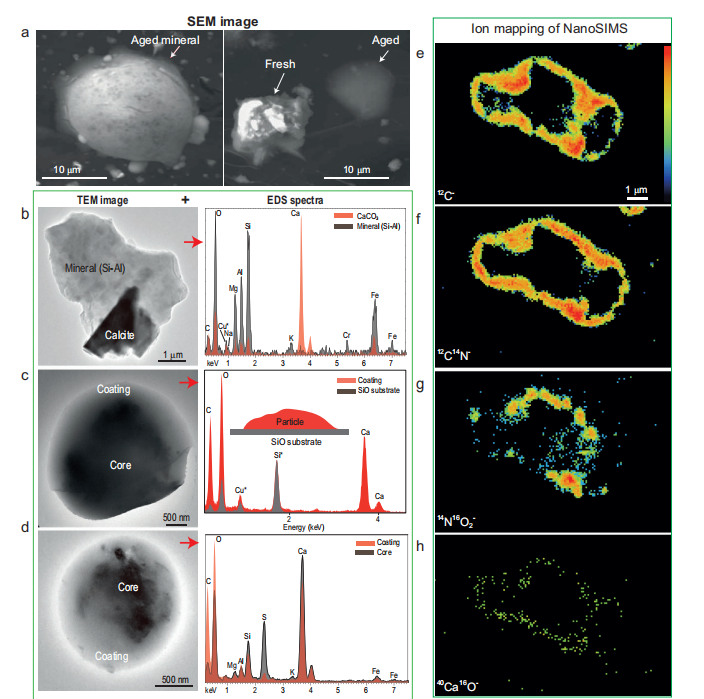

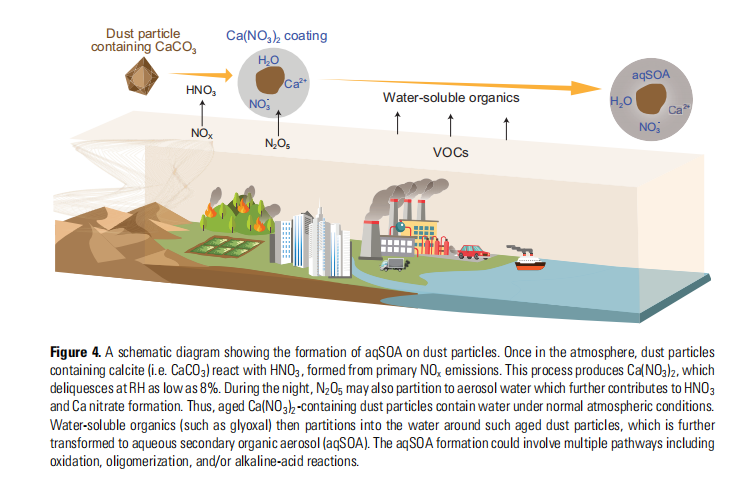
The study identified multiphase reactions as the key mechanism for aqSOA formation on aged dust: CaCO₃, a major component of mineral dust, reacts with atmospheric HNO₃ to form Ca(NO₃)₂ coatings. These coatings absorb water even at low RH, creating aqueous surfaces that facilitate the uptake and oxidation of water-soluble organics (e.g., glyoxal, a common precursor of aqSOA). Subsequent oxidation by photochemically generated OH radicals and oligomerization reactions produce less volatile organic species, and the detection of organosulfates—well-recognized aqSOA tracers—further confirms the aqueous-phase formation pathway.
Using the IMPACT chemical transport model, the improved simulation (incorporating glyoxal’s reactive uptake on dust particles) better reproduced field observations, overcoming the limitations of previous models that neglected dust’s role. The simulation predicts that aqSOA formed on dust contributes 16% of total SOA and 28% of total aqSOA globally over land, with the contribution reaching 67% and 74% across the “dust belt” (e.g., Central Asia, North Africa). This process shifts SOA distribution toward supermicron particles, which significantly extends SOA lifetime and alters atmospheric composition and radiative forcing, with potential impacts on regional and global climate.
The research concludes that aqSOA formation on aged nitrate-containing dust is a crucial, previously overlooked pathway in atmospheric chemistry. This finding urges the inclusion of this process in global chemical transport models, as it will improve the accuracy of predictions related to air quality, climate change, and marine biogeochemistry. Additionally, it provides new insights for mitigating air pollution and understanding the interactions between mineral dust and organic aerosols in the context of global climate change.
For details:
Weijun Li, Akinori Ito, Guochen Wang, Minkang Zhi, Liang Xu, Qi Yuan, Jian Zhang, Lei Liu, Feng Wu, Alexander Laskin, Daizhou Zhang, Xiaoye Zhang, Tong Zhu, Jianmin Chen, Nikolaos Mihalopoulos, Aikaterini Bougiatioti, Maria Kanakidou, Gehui Wang, Huilin Hu, Yue Zhao, Zongbo Shi, Aqueous-phase secondary organic aerosol formation on mineral dust, National Science Review, Volume 12, Issue 7, July 2025, nwaf221, https://doi.org/10.1093/nsr/nwaf221

 Add: No. 1 Hainayuan Building, Zijingang Campus, Zhejiang University,
 Tel: +86-571-87953269
 Fax: +86-571-87952875
 Email:
jiaxie@zju.edu.cn
Email:
jiaxie@zju.edu.cn