
Editor: 陈诺 Author: Time: 2026-09-17 Number of visits :10
From 22 to 30 August, students and faculty from the School of Earth Sciences at Zhejiang University took part in a summer exchange at the University of Manchester—a week that pushed them from lecture halls to city streets, and from textbook theory to hands-on practice in AI, energy, and climate science.
Touchdown in Manchester
The group landed in Manchester on 23 August. The city greeted them with unusually bright sunshine. After unpacking, students spent the afternoon in small groups—some getting to know the neighbourhood, others walking into the city for a first taste of this former industrial powerhouse of northern England.
Code First
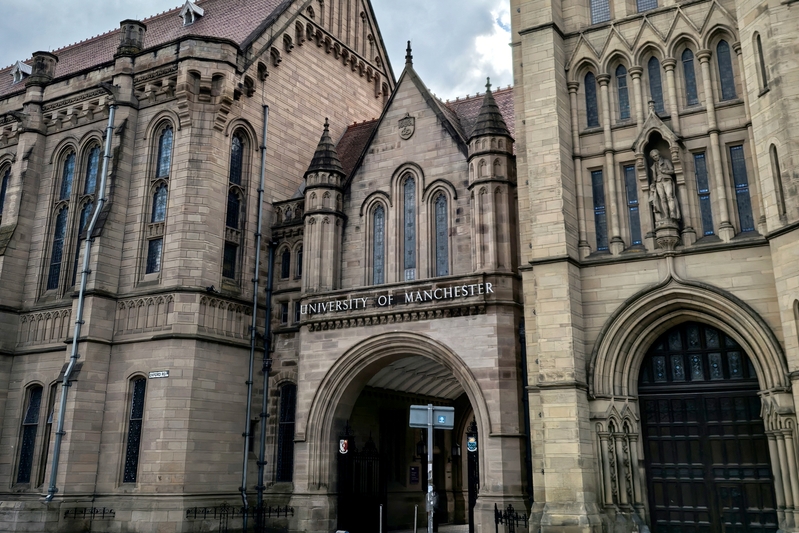
The programme opened on the next morning. Prof. David Topping of Manchester's Department of Earth and Environmental Sciences welcomed the group, joined by colleagues Prof. Zhonghua Zheng and Prof. Lin Ma.
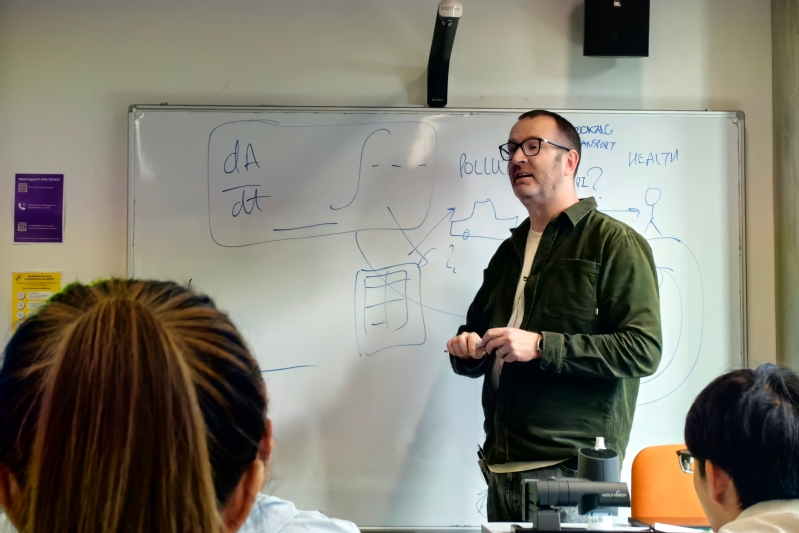
Professor Topping then led an introductory course on Google Colab and Python, guiding students through data processing, visualisation, and geospatial analysis. Later, his graduate students led a campus tour that included the Physics Building—associated with a long list of Nobel laureates—as well as the newer Graphene and Turing buildings.
AI, Energy, and the City
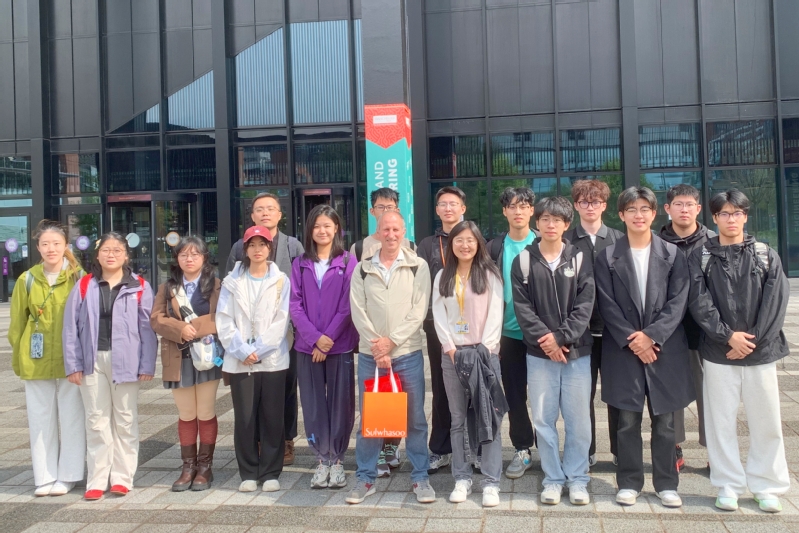
Over the following days, the group moved through a dense schedule of frontier topics. Prof. Zhonghua Zheng introduced core machine learning methods and their applications, and students used Microsoft's FLAML library to build predictive models from Manchester Airport temperature data bedore exploring urban climate simulation using the JULES and MORUSES models.
Prof. Kevin Taylor lectured on low-carbon energy systems—geothermal energy, hydrogen, geological storage, and carbon sequestration—connecting the science to China's dual carbon goals. Some students later visited Etihad Stadium and Old Trafford.
Prof. Lin Ma introduced the University of Manchester and its Nobel Prize-winning graphene research, then lectured on the global carbon cycle and renewable energy systems. Students also learned scientific image processing with ImageJ/Fiji.
Models, Memories, and the Journey Back
Midweek, Prof. Topping delivered a lecture on large language models. Using the example of teaching a model to recognise a cat, he explained supervised learning with characteristic humour, and discussed AI's potential in earth and environmental science.
At the closing ceremony, instructors presented certificates and commemorative gifts, and Prof. Lin Ma placed a University of Manchester scarf around each student's neck. The group then shared lunch at Nando's before spending the afternoon exploring the city—Old Trafford and Etihad Stadium, the Science and Industry Museum, the city centre, and the Gothic John Rylands Library.
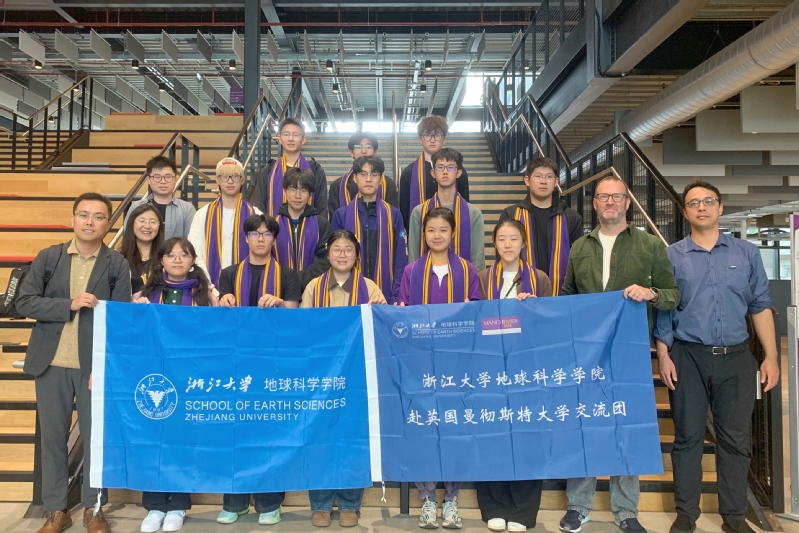
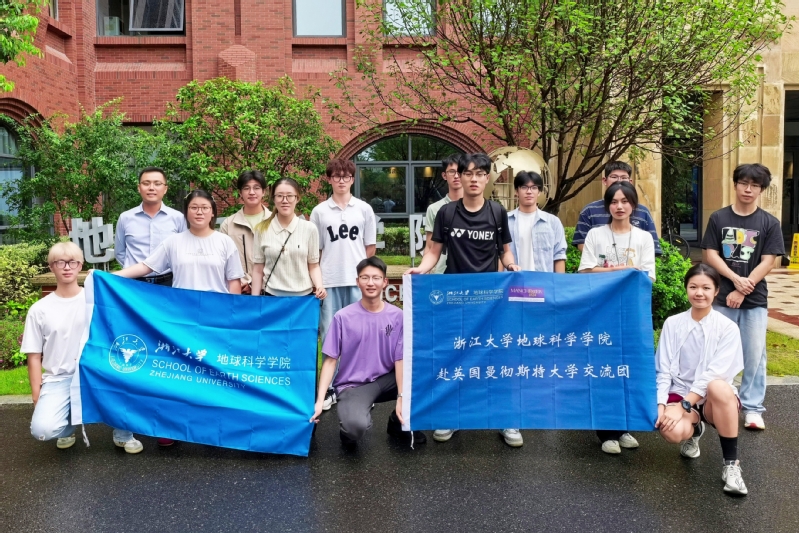
From the farewell photo in Hangzhou to the discussions in Manchester classrooms, from free exploration in the city to crossing day and night again on the return flight—the brief but full trip drew to a close. Students gained exposure to frontier knowledge in AI and environmental science, and broadened their horizons through different urban spaces, cultures, and ways of learning.
In Their Own Words
The courses combined theory with hands-on practice, introducing me to geospatial data science, AI applications in geoscience, and low-carbon energy. It broadened my academic horizons and showed me where my programming and interdisciplinary knowledge need strengthening.
— Xu
We encountered AutoML, RAG, and large language models, and learned how machine learning is applied in environmental and earth science. Compared with purely theoretical learning, this exchange helped me see the connections between different technologies.
— Shen
I had imagined an exchange would simply mean taking classes in a different place. But in a practice-oriented environment, I truly began to understand the design principles of machine learning and deep learning. It was the combination of academic and human exchange that made the experience so special.
— Hu
The exchange was both an academic and cultural gain. Walking through Manchester, red-brick factories and modern art galleries stood side by side, history and the present naturally intertwined.
— Guo
I was especially struck by Professor David's remarks on open collaboration—he noted that in AI, especially open-source models, China has shown an active and open posture. Hearing an overseas scholar describe China this way made me proud.
— Xie
The programme connected frontier science with geoscience, from data science to large language models. Professor Topping's humour and interactive teaching style made knowledge engaging and intuitive.
— Lin

 Add: No. 1 Hainayuan Building, Zijingang Campus, Zhejiang University,
 Tel: +86-571-87953269
 Fax: +86-571-87952875
 Email:
jiaxie@zju.edu.cn
Email:
jiaxie@zju.edu.cn